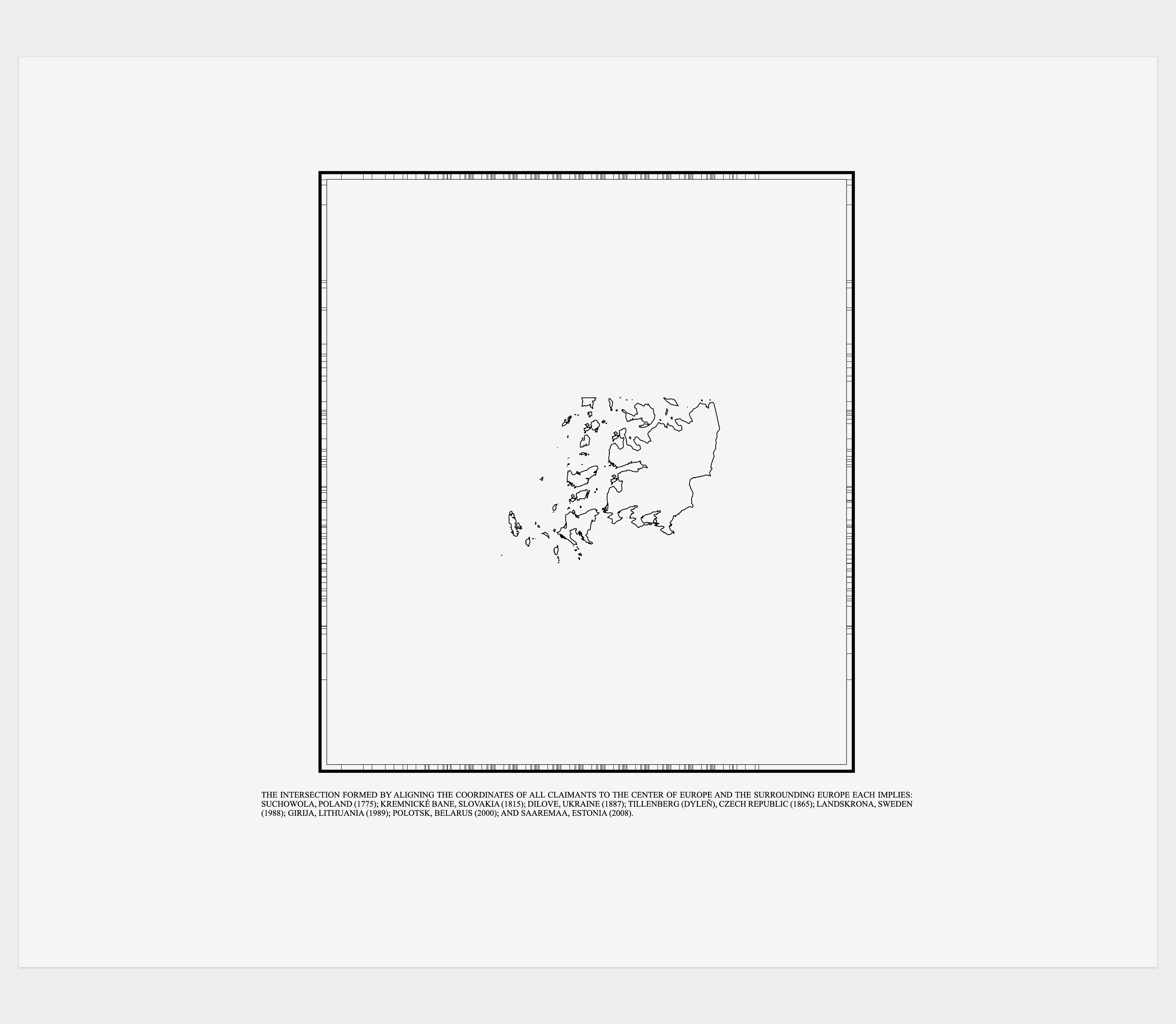
The intersection formed by aligning the coordinates of all claimants to the center of Europe and the surrounding Europe each implies: Suchowola, Poland (1775); Kremnické Bane, Slovakia (1815); Dilove, Ukraine (1887); Tillenberg (Dyleň), Czech Republic (1865); Landskrona, Sweden (1988); Girija, Lithuania (1989); Polotsk, Belarus (2000); and Saaremaa, Estonia (2008).
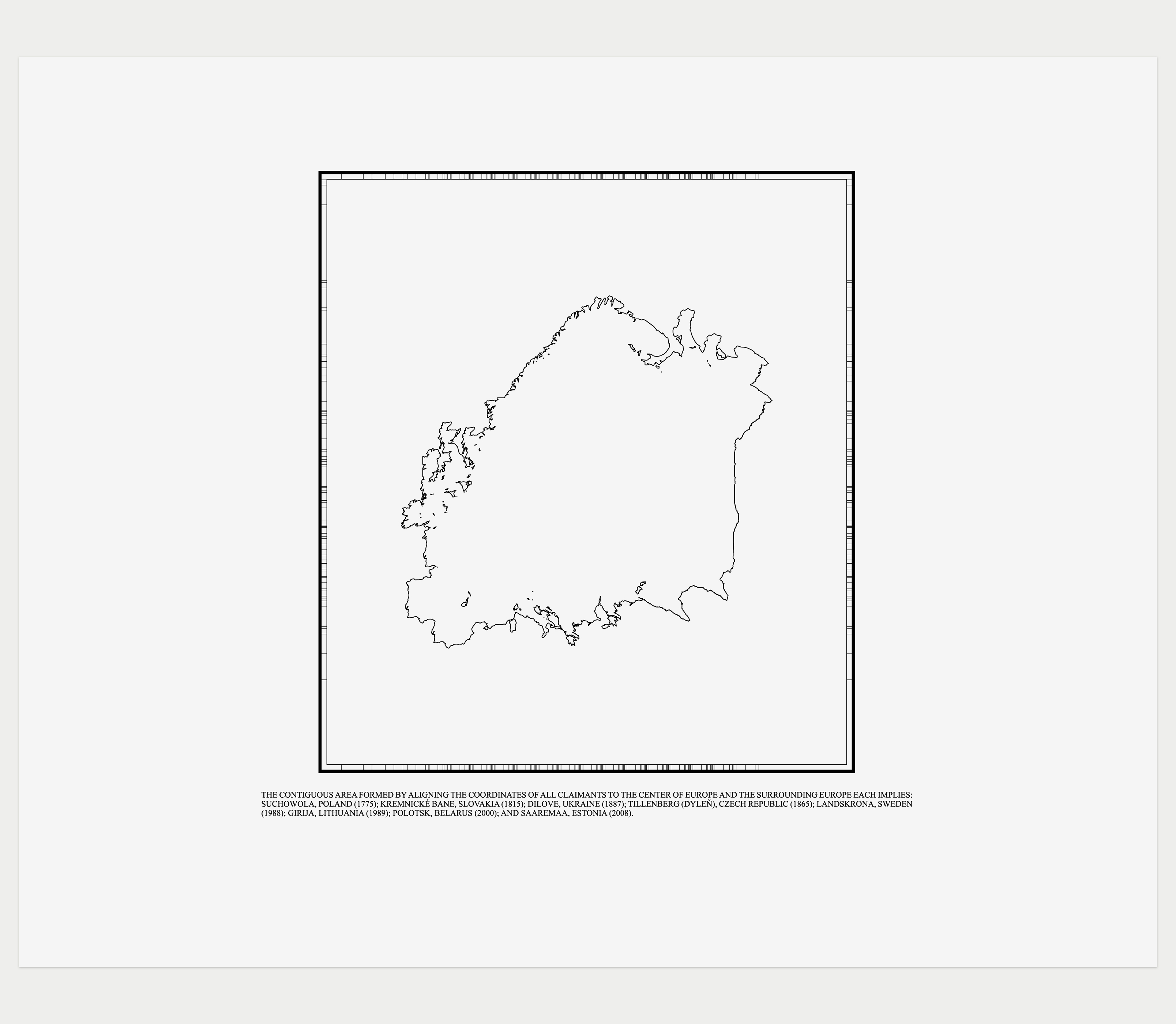
The contiguous area formed by aligning the coordinates of all claimants to the center of Europe and the surrounding Europe each implies: Suchowola, Poland (1775); Kremnické Bane, Slovakia (1815); Dilove, Ukraine (1887); Tillenberg (Dyleň), Czech Republic (1865); Landskrona, Sweden (1988); Girija, Lithuania (1989); Polotsk, Belarus (2000); and Saaremaa, Estonia (2008).
There is no single way to compute the geographic center of a region. And there are many geographic centers of Europe because of this.[1]
The decisions involved in a center calculation are diverse. You can compute the center of a political boundary, a cultural concept, or a land mass. You can choose to include islands or exclude large bodies of water. You can derive a center based on a thematic overlay, such as population density, or choose to incorporate elevation. You select a projection that distorts the area in question. Establishing centricity is deceptively ambiguous. And for every center of Europe, therefore, a surrounding Europe takes shape, which is different from the others.
These maps represent two imagined geographies that use the methodology and coordinates of previous center definitions to form the composite Europe of which the center is a single point. The resultant territories are the union and intersection of the “implied” Europes derived differently from eight center claimants—located in Poland, Slovakia, Ukraine, the Czech Republic, Sweden, Lithuania, Belarus, and Estonia—their corresponding center coordinates aligned on a single location.
The eight implied Europes, their centers aligned on a single point.
The territory that enables each claimant to be possible is, as a result, a non-place, formed of concession, modification, inclusion, and omission.